Top 5 Takeaways from Sister's New ‘Innovation Nation’ Report – Head of Innovation, Dr Karim Bahou
-1.jpg&w=3840&q=75)
For decades, the story of British innovation has been told through a narrow lens, focusing almost exclusively on the Golden Triangle between London, Cambridge and Oxford. While that success is certainly worth celebrating, the reality is that the UK innovation landscape has been undergoing a quiet evolution into a much more vibrant and dispersed network.
Across the country, regional ecosystems have been stepping up to become the engines of our innovation economy, leading to better and more resilient long-term national growth. With British innovation no longer confined to a single corner of the country, the UK stands at a critical turning point – one where the landscape is shifting and the map of innovation is being redrawn.
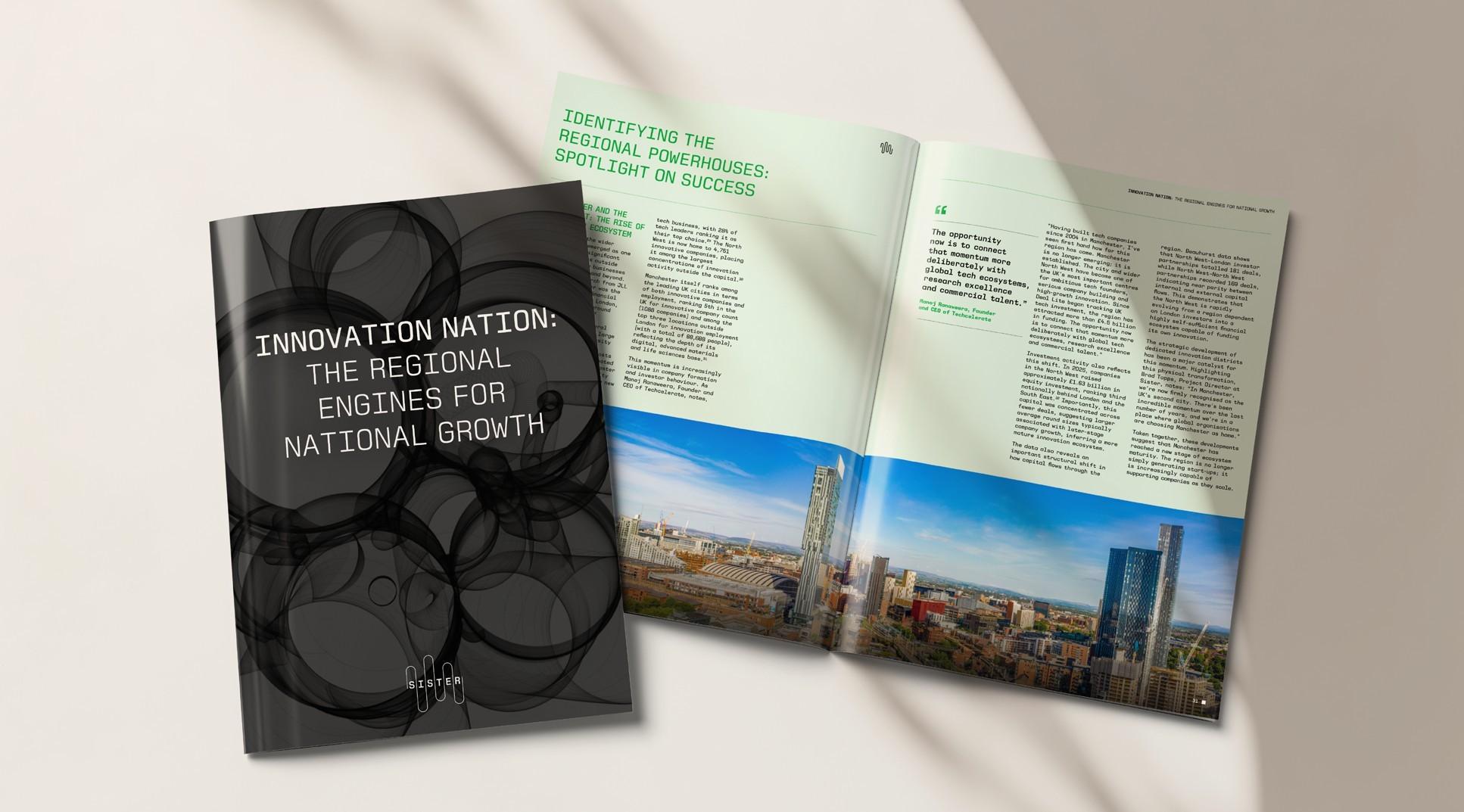
Our latest report, Innovation Nation: The Regional Engines For National Growth, explores this further.
The report provides an extensive overview of the new and rapidly growing innovation hubs across the country, underpinned by quantitative data developed by Beauhurst, with insights from over 30 innovation experts and leaders, including interviews with Faye Holland, Partnership Director of Cambridge x Manchester Partnership; Rupert Lyle, Fund Principal of the West Midlands Co-Investment Fund; Maria Lema, Co-founder and CEO of Weaver Labs; Julie Myint, Director & Patent Attorney of Gateley IP; Harvey Lowe, Co-Founder and CCO of Arcube, and Professor Nicholas Barnes, Founder & CEO of Celentyx.
Drawing on its key findings, we’ve mapped out the top five defining dynamics rewriting the rulebook of British innovation.
1. The UK needs more than just the Golden Triangle
While London, Oxford, and Cambridge still capture a massive 80% of UK venture capital, distributing investment further across the country is required to help drive more resilient and sustained national growth.
Mounting infrastructure challenges, like the prohibitive cost of commercial space and a lack of affordable housing, are creating significant barriers for early-stage companies and their talent in regions around the Golden Triangle. Driving balanced innovation across the UK will enable start-ups to extend their funding runway and free their ambitions to grow.
2. The rise of regional hubs
Looking beyond the capital, regional ecosystems are growing rapidly across the UK. Bristol, Edinburgh and Manchester have grown by up to 66% since 2019.
Manchester has clearly emerged as a leading innovation cluster outside of London, second only to Edinburgh when it comes to the number of innovative businesses.
More broadly, what we can see is that the UK innovation system is evolving into a network of regional clusters. As Brad Topps, Project Director at Sister, states in the report:
“The UK’s future will not be driven by one region alone. It will be powered by a constellation of city-regions.”
3. Innovation corridors as growth engines
National innovation works better together as a collaborative whole, with the dynamic flow of talent, capital, and research across regions.
Cities like Manchester, Birmingham and Leeds perform brilliantly in isolation, however, the lack of collaboration between them is a missed opportunity.
Scotland is a leading example of where this works in action through greater devolution of powers to set their own innovation agenda. Edinburgh and Glasgow have the most integrated city-to-city network in the entire UK, continually reinvesting investment and grant capital within the region.
The Scottish model could be scaled across the UK too. There is enormous potential to be unlocked by linking up places like Manchester, already an incredibly strong hub on its own, with other northern cities, such as Sheffield and Leeds, and building out further those regional links and emerging connections.
4. Building the conditions for regional innovation
Successful innovation ecosystems rely on a deliberate physical setup to get things done. Capital alone is never a magic bullet if a city’s assets – its universities, incubators and laboratories – remain disconnected or inaccessible.
True regional momentum depends on creating vibrant, mixed-use spaces that bring researchers, businesses, and investors into regular contact.
Investing in infrastructure to support businesses is vital; people need to be able to live near where they work and commute efficiently. Furthermore, investing in the wider urban infrastructure is essential to creating the right conditions for regional innovation.
By putting mature enterprises alongside early-stage businesses, innovation districts like Sister can provide both the environment and practical spaces, from testing facilities to shared workspaces, needed to support growing firms.
Ultimately, if we want valuable ideas and talent to actually stay in our regional economies, we must build connected networks where transport, affordable housing, and physical workplaces all back each other up.
5. The UK excels at early innovation but struggles with commercialisation
The UK does not lack talent or ambition; it lacks the systemic machinery to commercialise them at scale.
As a recent report from UK Parliament notes: “Our capital markets and financial institutions fail to connect our investors and inventors at the scale required to build and grow world-leading firms.” The report also highlights how 94% of UK scale-ups are “acquired before they reach maturity – half by overseas buyers.”
For example, a recent article from the Financial Times highlighted how Google bought DeepMind for £400mn, which they noted “now looks like one of the biggest bargains in dealmaking history.”
We are a global powerhouse in academic output and start-up volume, yet we consistently struggle when turning that scientific brilliance into internationally dominant market leaders.
Shifting focus within our universities from publishing academic papers to commercialising research through industry engagement is the primary obstacle we have to clear.
Our call to action: a manifesto for regional growth
The UK has reached a pivotal moment. After decades of centralised investment and an innovation landscape shaped overwhelmingly by London, there should now be a drive towards a more distributed national model. One that recognises the unique geography, academic strength and regional momentum in the UK.
This is Sister’s manifesto for regional growth, calling on action for change-makers who can help turn this vision into a reality:
- Policymakers: Right now, R&D tax credits are nationally controlled and uniform. To enable place-based innovation, we need devolved R&D incentives. This requires rethinking how they are allocated and who has the authority to deploy them, allowing us to move beyond a ‘one-size-fits-all’ model.
- Investors: To truly back British innovation, we need regionally focused funds that can bring together private investors, pension funds, sovereign wealth capital and local institutions to de-risk early-stage and scale-up investment outside the capital.
- Developers: To improve the speed and success rate of scaling businesses, we need to create the physical infrastructure that shapes positive commercial outcomes. This means creating districts and spaces where companies have access to pilot labs, R&D suites, accelerator floors, co-located corporate partners and university facilities.
Taken together, these actions can help the UK transition from a nation that produces world-class research to a nation that commercialises it. It can move from a top-heavy system to a distributed one, and in doing so, realise its full potential as an innovation superpower.
The opportunity is real, the evidence is clear, and the momentum is already visible across the regions. The next step is simply choosing to act.
If you’re interested in learning more, you can download the full report here: https://sistermanchester.com/news-and-insights/innovation-nation-report.
Related

Contact us to find out more about Sister
Contact us to find out more about Sister